
Asbestos Exposure & Mesothelioma
Nearly every case of mesothelioma traces back to asbestos. Understanding how and where exposure happens — and who is most at risk — can help you and your family make sense of a diagnosis and understand your options.
Get Your Free Road Map Guide
See what help you may qualify for. Tell us a little about your situation and your free guide downloads instantly.
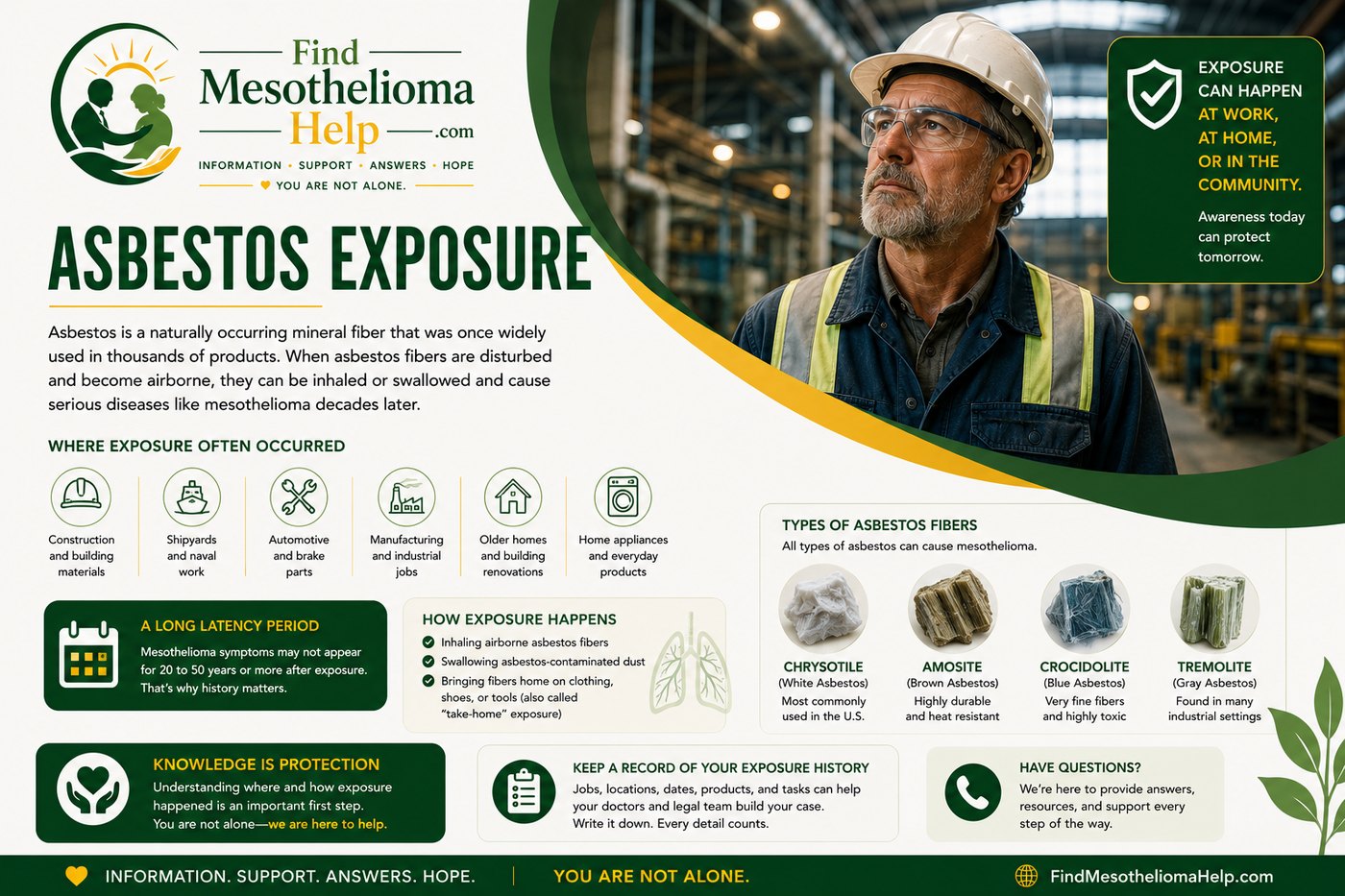
Asbestos is a group of naturally occurring minerals that were prized for decades because they resist heat, fire, and corrosion. That same durability makes them dangerous: when asbestos products are cut, sanded, drilled, or simply age and crumble, they release tiny fibers that are easy to inhale and nearly impossible for the body to expel.
How exposure happens
On the job
Occupational exposure is the most common source. Workers who built ships, worked in power plants and refineries, installed insulation, worked in construction, or repaired brakes were often surrounded by asbestos every day.
Military service
Asbestos was used heavily throughout the armed forces — especially in Navy ships and shipyards — which is why veterans make up a significant share of mesothelioma cases.
Secondhand (take-home) exposure
Family members were sometimes exposed when a worker unknowingly carried fibers home on their clothes, hair, and tools. Spouses who laundered work clothes and children who hugged a parent after a shift have developed mesothelioma this way.
Environmental exposure
People who lived near asbestos mines, factories, or contaminated sites could also be exposed through the air and soil.
Who is most at risk
Risk is highest for people who worked directly with asbestos and their household members. Because symptoms can take decades to appear, exposure that happened in the 1960s, 70s, or 80s may only be causing illness now.
Were you or a loved one exposed?
Our free guide explains what exposure may mean for your health and the compensation you could be owed.
Download the Free Guide